
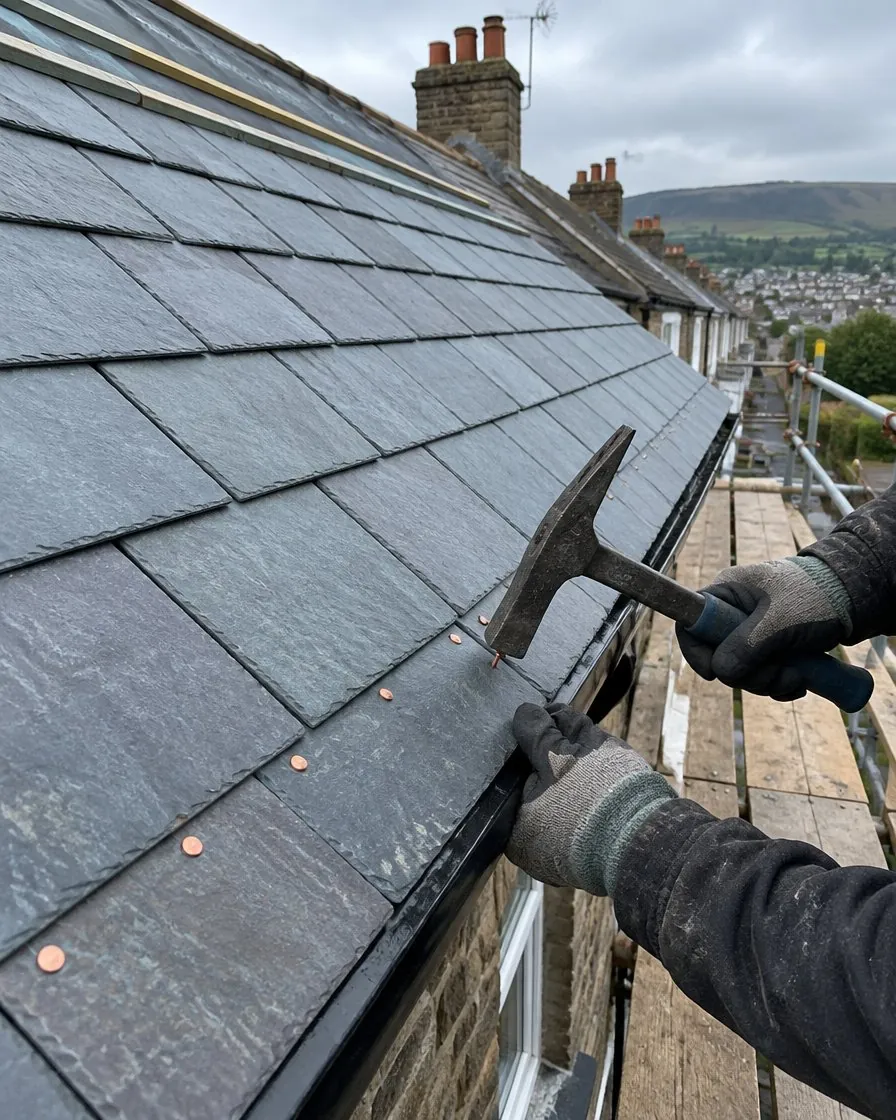
Walk through the older parts of Dartmouth and almost every roof is slate. Victorian terraces, Edwardian villas, farmhouses and cottages across Dartmouth, TQ6 were all roofed in it, and most of those roofs are still carrying the original slates. That tells you how good the material is. Nearly every problem we're asked to look at on a slate roof in Dartmouth comes down to the fixings rather than the slates: the iron nails have rusted through, the slates have started to slip, and water is finding its way in. The slates themselves are very often perfectly reusable.
Slate roof repairs in Dartmouth
If a few slates have slipped or cracked in one area, a repair is the right answer. We refix slipped slates with copper or stainless steel tingles so they can't move again, replace broken slates with matching reclaimed ones, re-bed loose ridge and hip tiles, and renew the lead in valleys and around chimneys where it has split or lifted. Most repairs on a Dartmouth terrace are done from a ladder or a small tower in a day, and we photograph the roof before and after so you can see what was done.
The one thing we won't do is patch a roof that needs re-slating. If slates are slipping all over the roof rather than in one patch, the nails have gone everywhere, and every repair just moves the problem along. That's nail sickness, and we'll tell you honestly when we see it.
Re-slating a roof in Dartmouth
Re-slating means stripping the roof, saving and grading your existing slates, fitting new breathable membrane and treated battens, and re-laying the roof using your own good slates topped up with matching reclaimed or new ones. On a typical Dartmouth terrace we save sixty to eighty per cent of the original slates, which keeps the cost down and keeps the roof looking exactly as it should on the street.
- Strip and sort. Slates come off carefully, are rung to check they're sound, and are stacked by size and thickness.
- Timbers checked. With the roof open we check every rafter, the wall plates and the valley boards, and replace anything soft. This is the only time it's cheap to do.
- Membrane and battens. Modern breathable underlay replaces the old felt or, on many Dartmouth roofs, no underlay at all. New treated battens are set to gauge for your slate size.
- Re-laying. Slates are laid to the original coursing, fixed with copper nails, with new lead valleys, soakers and flashings and either a mortar or dry ridge system as you prefer.
- Details. Verges, eaves, abutments and chimneys are where slate roofs leak, so these get the most attention and the most photographs.
Reclaimed, Welsh or Spanish slate?
For an old roof in Dartmouth, good reclaimed Welsh slate is the best match and usually the most economical, because your own slates go back on and we only buy in what's needed to top up. Where we need to source matching slate we'll bring samples so you can compare colour and texture against your roof. For a complete new slate roof on an extension or new build in Dartmouth, TQ6, Spanish slate gives excellent value with a life of 75 years or more, and new Welsh slate gives the longest life of all at a higher price. We'll be straight with you about the difference and what makes sense for your budget.
Period properties and conservation work
Parts of Dartmouth are in conservation areas and a number of properties across Dartmouth, TQ6 are listed. On these roofs the slate type, size, coursing and detailing have to match the original, and the conservation officer may want to see samples. We've done this many times and can work with your conservation officer where consent is needed. Diminishing courses, random-width slating, swept valleys and stone ridge details are all things we're comfortable with.
Why slate suits Devon weather
Slate is dense, non-porous and completely unaffected by frost, salt air or UV, which is why it has lasted so long on the roofs of Dartmouth. It doesn't grow moss the way concrete tile does, it doesn't fade, and it can be lifted and reused several times over its life. The weak points are the fixings and the lead, and those are exactly what a proper re-slate renews.
Signs your slate roof in Dartmouth needs attention
Slate roofs fail slowly, which is why problems in Dartmouth are often left until water is coming through a bedroom ceiling. The earlier you catch it the cheaper the fix. Look for slates lying in the garden or the gutter after wind, which means the fixings have gone. Look at the roof from across the street for slates that sit proud or at a slight angle to their neighbours, which is the first sign of slipping. Look for white or rust-coloured streaks below the ridge or the chimney, which point to failed mortar or lead. Inside the loft, daylight through the roof or damp staining on the underside of the slates and on the rafters means water is getting in. If you see any of these on a Dartmouth roof, a quick inspection now will tell you whether it's a few slates or the start of nail sickness.
It's also worth knowing what isn't a problem. Slates vary in colour and some weather to a lighter grey; that's normal. A little lichen on a north slope doesn't harm slate the way moss harms concrete tile. And a roof that has been patched over the years with a few different slates is fine as long as the fixings are sound.
Slate roofers covering Dartmouth and Dartmouth, TQ6
Dartmouth Roofing is based in Dartmouth and works across the whole of Dartmouth, TQ6. We give written quotes after inspecting the roof, we explain whether you need a repair or a re-slate and why, and we photograph everything so you can see the work you've paid for. Call us on 07723 607 800 or request a quote and we'll arrange a visit.